
Will Germany's Balcony Solar Make it in the U.S.?
Germany made the balcony solar panel an everyday appliance. Nine U.S. states have now followed with laws of their own. Here's how they compare, and what condominium boards should consider before the technology reaches Hawaiʻi.
Europe's Balcony Solar BoomHow Germany turned the plug-in solar panel into an ordinary household appliance.
What the Rules Allow
How It Works
Sources: Bundesnetzagentur; Umweltbundesamt; Marktstammdatenregister, May 2026. | |||||||||||||||||||||||||||||||||||
Plug-In Solar Reaches AmericaOne state allowed it in January. Nine allow it now.
How Far It Has Spread
The Year in Brief
The Safety Framework
Sources: Canary Media; National Caucus of Environmental Legislators; UL Solutions; Environment America. | |||||||||||||||||||||||||
Comparing Standards & RegulationsHow the German and American rules compare.
Sources: Bundesnetzagentur; Umweltbundesamt; UL Solutions; Intertek; National Caucus of Environmental Legislators. |
Growth
Owners. Since October 2024, the system has been a privileged alteration under German law. A condominium owner may require the association to permit it. The association decides how, not whether. A resolution is still required before installation. (Haufe)
Paperwork. One free online entry in the federal registry replaced the former two-step filing. (Bundesnetzagentur)
Bills. A vertical 800 W balcony system yields about 530 kWh a year. Without storage, about 45 percent is used at home as it is produced, saving roughly €90 a year. (Umweltbundesamt)
Plug-In Solar in the United States
At the start of 2026, only Utah had legalized plug-in solar. Nine states now have laws on the books, including Virginia, Colorado, Connecticut, and New Jersey. New Jersey became the most recent on September 1, 2026. Three more states have passed bills that await their governors' signatures, including California. (Canary Media; Canary Media, state tracker)
At least 31 states considered plug-in solar legislation in 2026. The common model defines small systems under 1,200 watts and exempts them from utility interconnection requirements. (National Caucus of Environmental Legislators)
Limitations
Adding a battery generally still requires notice to the grid operator. (Verbraucherzentrale)
A 2025 safety standard permits a standard household plug only up to 960 Wp of panels. Larger arrays require a dedicated energy socket. (Umweltbundesamt)
Surplus power sent to the grid earns no payment under the simplified rules. (Bundesnetzagentur)
The Safety Framework
UL Solutions launched a dedicated testing and certification program on January 8, 2026. It is based on UL 3700, an Outline of Investigation for plug-in photovoltaic equipment and systems. An outline is a working framework, not yet a finalized consensus standard. (UL Solutions)
UL 3700 addresses equipment designed to connect through a dedicated plug-in photovoltaic receptacle. (Intertek)
The first certifications cover micro-inverters. Hoymiles and APsystems announced micro-inverters certified by CSA Group, a nationally recognized testing laboratory. (Environment America)
The Wrap
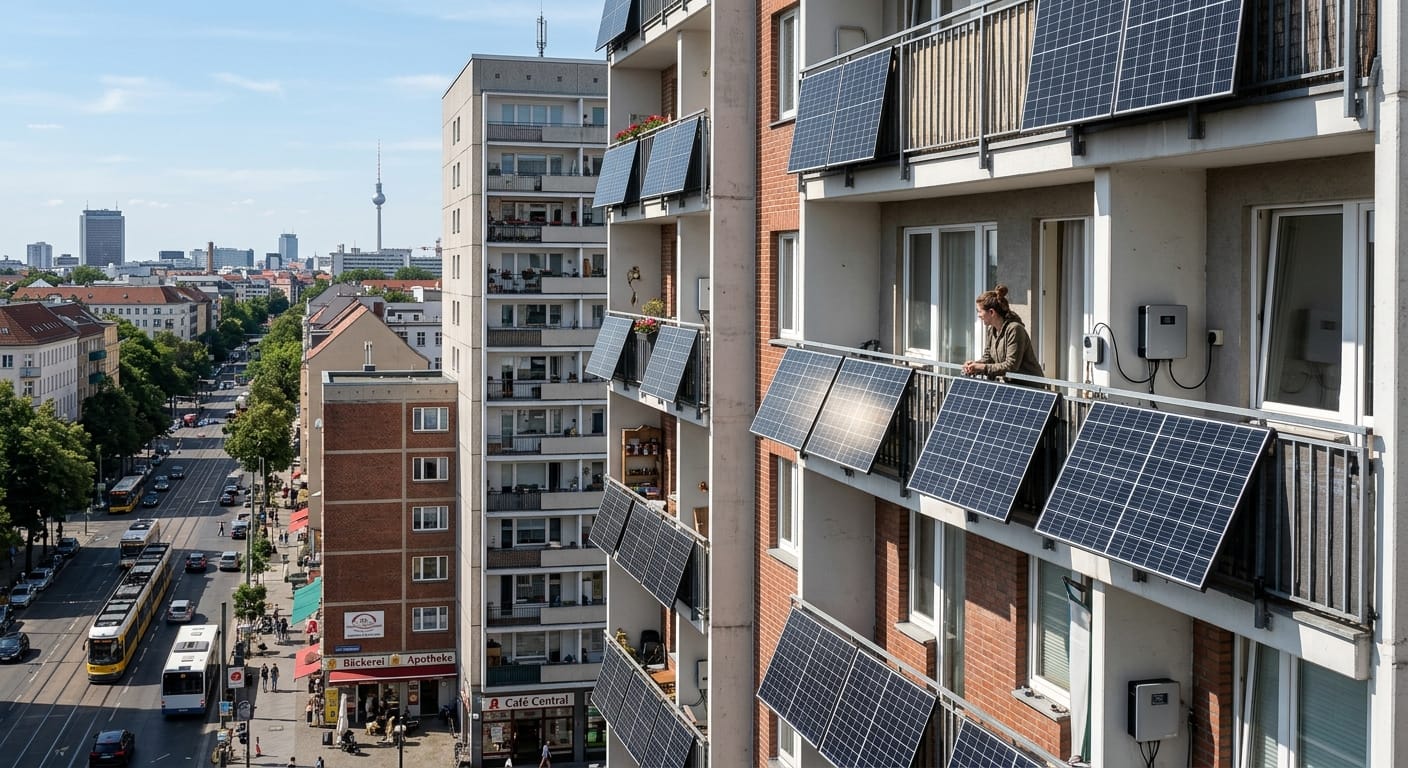
Germany has shown that a small solar panel on a balcony railing can become an ordinary household appliance. The rules there are simple. One registration, a modest output limit, and a clear safety standard.
The United States is moving in the same direction, at speed. Nine states adopted plug-in solar laws in 2026, and a national safety framework is taking shape. Hawaiʻi is not yet among those states.
For condominium owners and boards, the German model is worth studying closely. There, an association may decide how a system is installed, but not whether. Should similar legislation reach Hawaiʻi, boards will face the same question. A thoughtful policy on appearance, mounting, and wind load would place any building ahead of it.
We will continue to follow the legislation and the certification work, and we will report as it develops.
Sources
Germany: Bundesnetzagentur, plug-in solar rules; Bundesnetzagentur, 2025 expansion data; Umweltbundesamt, plug-in solar overview; Umweltbundesamt, household savings; Umweltbundesamt, registry count to 2024; Verbraucherzentrale; Haufe, § 20 WEG and § 554 BGB.
United States: Canary Media, state tracker; Canary Media, 2026 overview; National Caucus of Environmental Legislators; UL Solutions; Intertek; Environment America; APsystems, CSA certification to UL 3700.