
Hawaiʻi is Losing Workers and Consumers at the Same Time
Hawaiʻi is losing its workforce and its consumer base at the same time. Economic opportunity is the remedy that stabilizes the decline.
By the Numbers
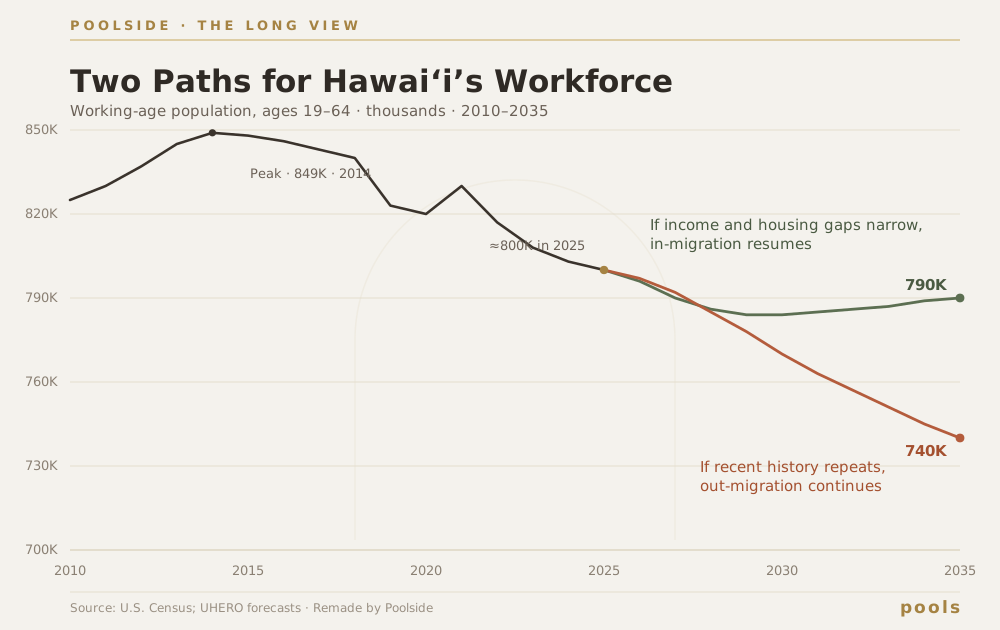
Hawaiʻi's working-age population peaked near 850,000 in the mid-2010s. Today, it stands at nearly 800,000.
The University of Hawaiʻi Economic Research Organization (UHERO) released its forecast on September 1, 2026, drawing on Census data. It makes for stark reading.
UHERO's founding member, Executive Director, and Professor of Economics, Carl Bonham, characterizes the most favorable reading as "flat and stable," anticipating roughly zero job growth for the year. He goes on to note that:
- Hawaiʻi has lost jobs in 8 of the last 12 months.
- Employment declined by roughly 400 per month over the last quarter.
- Between July 2024 and July 2025, the state shed almost 2,000 jobs — a decline of about 0.3%.
Bonham also highlights that there are only two paths forward for Hawaiʻi:
- The decline slows and flattens out around 790,000
- The population drops below 740,000 by 2035 and continues its sharp decline thereafter.
Which end arrives depends on economic diversification, income growth, and an increase in housing supply, occurring concurrenlty over the next 12-24 months.
The Tourism Paradox: 1M Fewer Visitor Days
More arrivals. Fewer nights. Less spending.
Highgate's Kelly Sanders emphasized how heavily the industry now relies on the kamaʻāina market — a tacit acknowledgment that local demand is a pillar, not a supplement.
Hawaiʻi's demand problem is compounded by geography. Its two customer pools are both exposed: the local base is shrinking as residents leave, and the visitor base is dangerously concentrated in a single foreign-turned-domestic market.
The 2026 visitor data (DBEDT, tracking Hawaii Tourism Authority figures):
- July 2026 arrivals in fact rose to 883,248 visitors — an increase of 1.1% YOY.
- Yet the state lost more than 1 million actual visitor days, as trips grew shorter.
- The average length of stay for visitors fell to 7.59 days — down 14.1% from 8.83 days a year earlier.
Japan's Declining Arrivals
2026 marks Japan's 17th consecutive year of population decline.
Statewide, arrivals from Japan peaked at nearly 1.57 million visitors just before the pandemic. American travelers now account for over 80% of all Hawaiʻi visitor spending.
- In 2019, roughly 24% (nearly 1 in 4) of all tourists on Oʻahu were from Japan.
- Recent data shows that only about 1 in 8 Oʻahu visitors now comes from Japan, totaling just over 715,000 to 720,000 people annually.
- Over the last several years, traffic from Japan has consistently hovered at roughly half of its pre-pandemic volume (around 46% to 50%).
Japan's Ongoing Demographic Collapse
- The national census recorded a drop of more than 3 million people over five years — from 126 million to roughly 123 million — the sharpest since record-keeping began in 1920.
- Its record-high median age is now 50.2 years with roughly 30% of its population now 65 or older.
- Per UN World Population Prospects. Japan’s decline of Japanese nationals is steeper still — a record 908,574 in a single calendar year — as a modest rise in foreign residents only partially offsets the total.
This is an aging, cost-pressured population that travels less — and Hawaiʻi's former leading foreign market is a demographic casualty of the very force now reshaping Hawaiʻi itself.
The Economic Effects
64 countries and territories have already passed their peak population as of 2026 - per the UN and Our World in Data
The IMF finds G7 nations confronting slower economic momentum tied directly to shrinking labor forces — and rising tax burdens to fund elderly care. Hawaiʻi's version of that pressure appears in the state's own accounts:
- Hotel occupancy is projected at 79.4%, down from 86% before the pandemic — a decline that ripples through airlines, restaurants, retailers, and small businesses statewide.
- Holiday bookings for the coming winter are pacing approximately 20% lower year-over-year, translating directly into reduced working hours for local hospitality staff.
- Total Transient accommodations tax (TAT) revenue is now projected to end at $860 million for 2026 — a $240 million shortfall from the $1.1 billion collected previously. That is funding for schools and public infrastructure, diminishing as visitor days decline.
Highgate's leadership warns that, absent substantial state reinvestment in destination marketing, Hawaiʻi risks long-term retail and hotel closures — the physical manifestation of a demand base that no longer supports the footprint built for it.
The Wrap
The defining economic force of this era is neither a recession nor a boom. It is demography — and specifically, the reality that a shrinking working-age population subtracts from both sides of the ledger at once.
Sixty thousand workers = sixty thousand local consumers. Fewer workers to produce. Fewer customers to purchase. Fewer taxpayers to fund the system.
UHERO's warning is explicit:
- It is likely a recovery of Hawaiʻi's labor-consumer base may no longer be possible.
- Stabilization of Hawaiʻi's economic decline is now the only option.
- However, a flattening out towards ~790,000 only occurs if income growth and economic diversity increase to narrow affordability gaps.
Sixty-four countries are already beyond the peak. Diversifying Hawaiʻi's economy is existential to its economic stability.
Sources: UHERO (University of Hawaiʻi Economic Research Organization) working-age population forecast, September 1, 2026; U.S. Census Bureau. Hawaiʻi visitor statistics: DBEDT / Hawaii Tourism Authority; Office of the Governor of Hawaiʻi; Honolulu Civil Beat. "Spotlight Now" on Hawaii News Now — host Ryan Kalei Tsuji, with Dr. Carl Bonham (UHERO) and Kelly Sanders (Highgate Hawaiʻi). Global figures: UN World Population Prospects; Our World in Data; U.S. Congressional Budget Office; International Monetary Fund.